
12 Achievements Unveiled to Elevate China-ASEAN Law-Business Integration——2026 China-ASEAN Commercial Law Forum was held in Nanning successfully

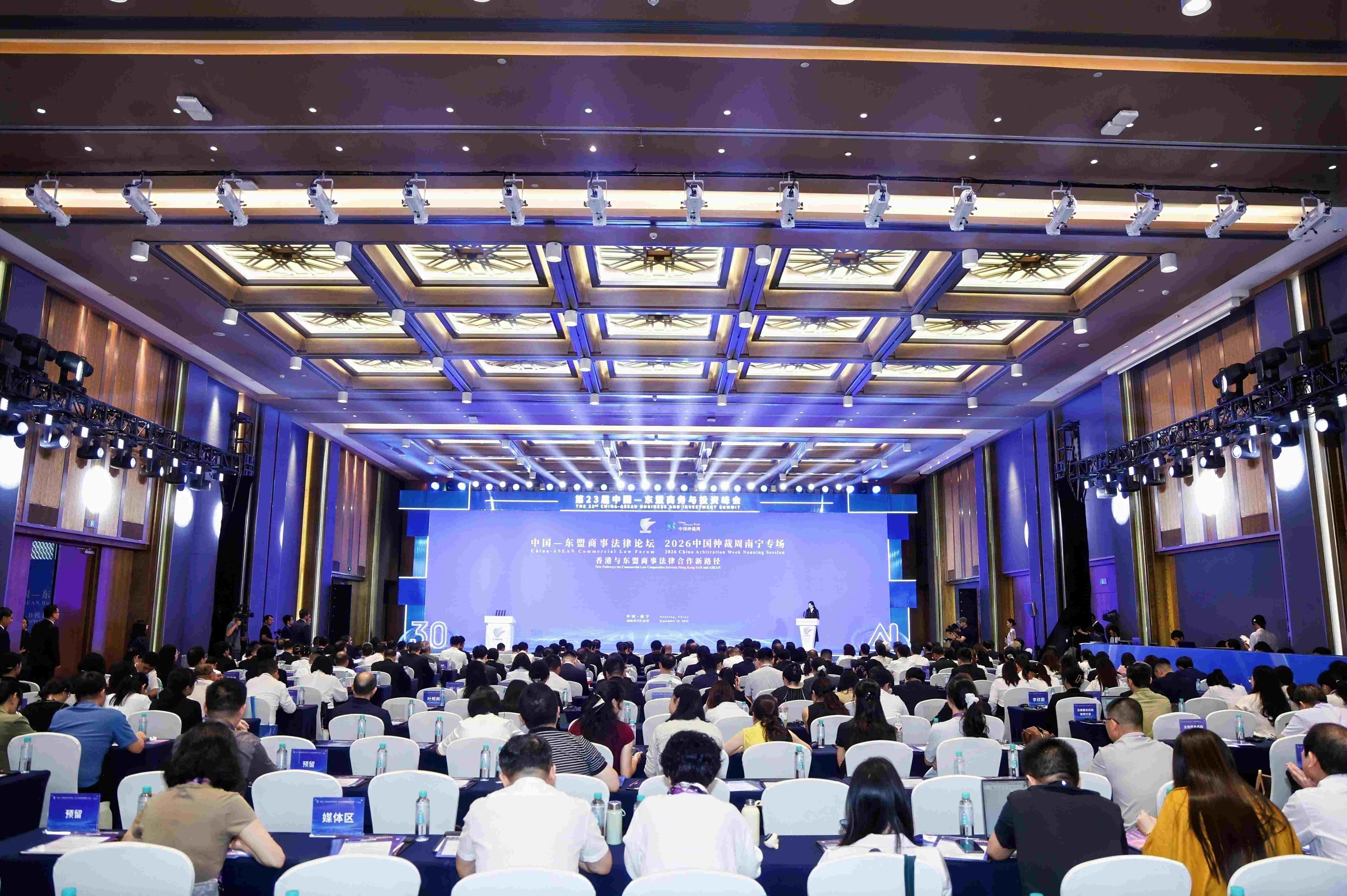
As the crisp autumn air brings a season of harvest and abundance, the “China-ASEAN Commercial Law Forum-2026 China Arbitration Week Nanning Session”, a parallel forum of the 23rd China-ASEAN Business and Investment Summit, was held in Nanning, Guangxi on September 18, 2026. This Forum was co-hosted by the China Council for the Promotion of International Trade (CCPIT), the People’s Government of Guangxi Zhuang Autonomous Region, and ASEAN national chambers of commerce and industry, with special support provided by the Hong Kong International Legal Talent Training Academy of the Department of Justice, the Government of Hong Kong Special Administrative Region, the International Organization for Mediation (IOMed), and other supporting organizations. Mr. Huang Hailong, President of the Guangxi High People’s Court, Ms. Lin Honghong, vice Chairperson of CCPIT, and Mr. Li Yongli, President of the Chongqing High People’s Court and other distinguished guests attended the Forum and delivered remarks. Mr. Paul T K Lam, Senior counsel, Secretary for the Department of Justice of Hong Kong SAR, and Professor Teresa Cheng, Secretary-General of the International Organization for Mediation, delivered their speeches via video. Over 300 representatives from judicial institutions, arbitration communities, business and industry sectors, legal service institutions, and renowned enterprises in the Chinese Mainland, the Hong Kong Special Administrative Region, and ASEAN countries gathered in Nanning for in-depth discussions and exchanges on topics including new models for cross-border legal cooperation and the alignment of regional rules.
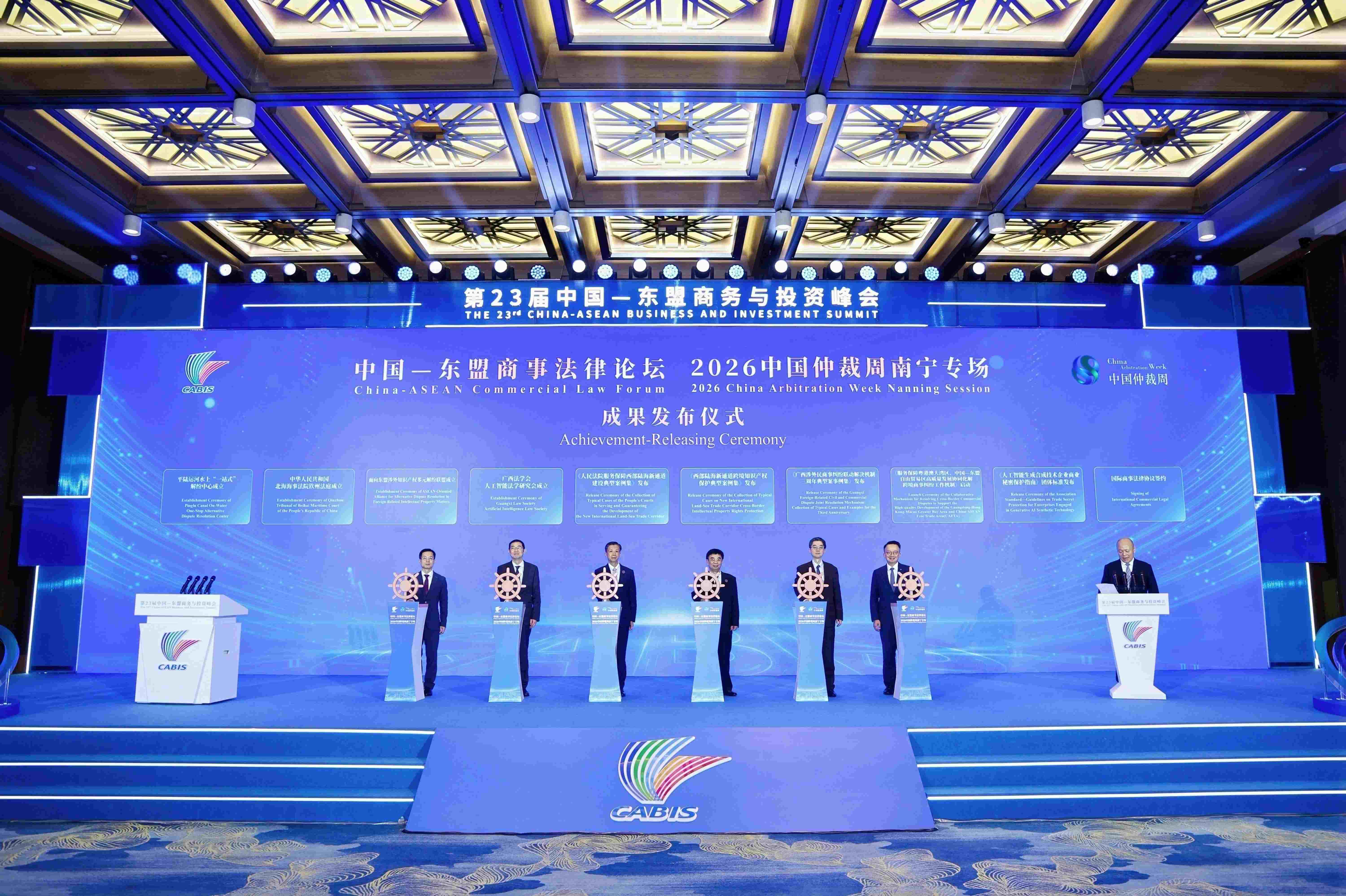
2026 marks the fifth anniversary of the establishment of the China-ASEAN Comprehensive Strategic Partnership, and is also a crucial year for the roll-out and implementation of the China-ASEAN Free Trade Area 3.0. Against the backdrop of profound shifts in the international economic and trade landscape, cross-border investment and trade interactions have grown increasingly robust. The legal environment governing commercial activities has become more complex, and enterprises have seen rising demand for full-chain services covering legal compliance, risk prevention and dispute resolution. With the official opening-to-navigation of the Pinglu Canal, the river-sea intermodal capacity of the New International Land-Sea Trade Corridor will be significantly enhanced. As regional cross-border trade and the digital economy thrive, the demand for the alignment of economic and trade rules and commercial legal services has become increasingly diverse and urgent. Leveraging the institutional strength of “One Country, Two Systems”, Hong Kong’s common law system is highly compatible with international commercial rules, and its robust legal services sector offers unique advantages in areas such as maritime and commercial law and cross-border commercial dispute resolution. The Forum, with the theme “New Pathways for Commercial Law Cooperation between Hong Kong SAR and ASEAN,” centered on three main threads: “Hong Kong SAR-ASEAN legal connectivity, legal safeguards for the Pinglu Canal, and integration of artificial intelligence and legal services”, explored to build an innovative service system featuring “Hong Kong’s legal practices + Guangxi’s integrated platforms + ASEAN-oriented application for cooperation” and produced a series of commercial legal outcomes that focused on business concerns and met the development needs.
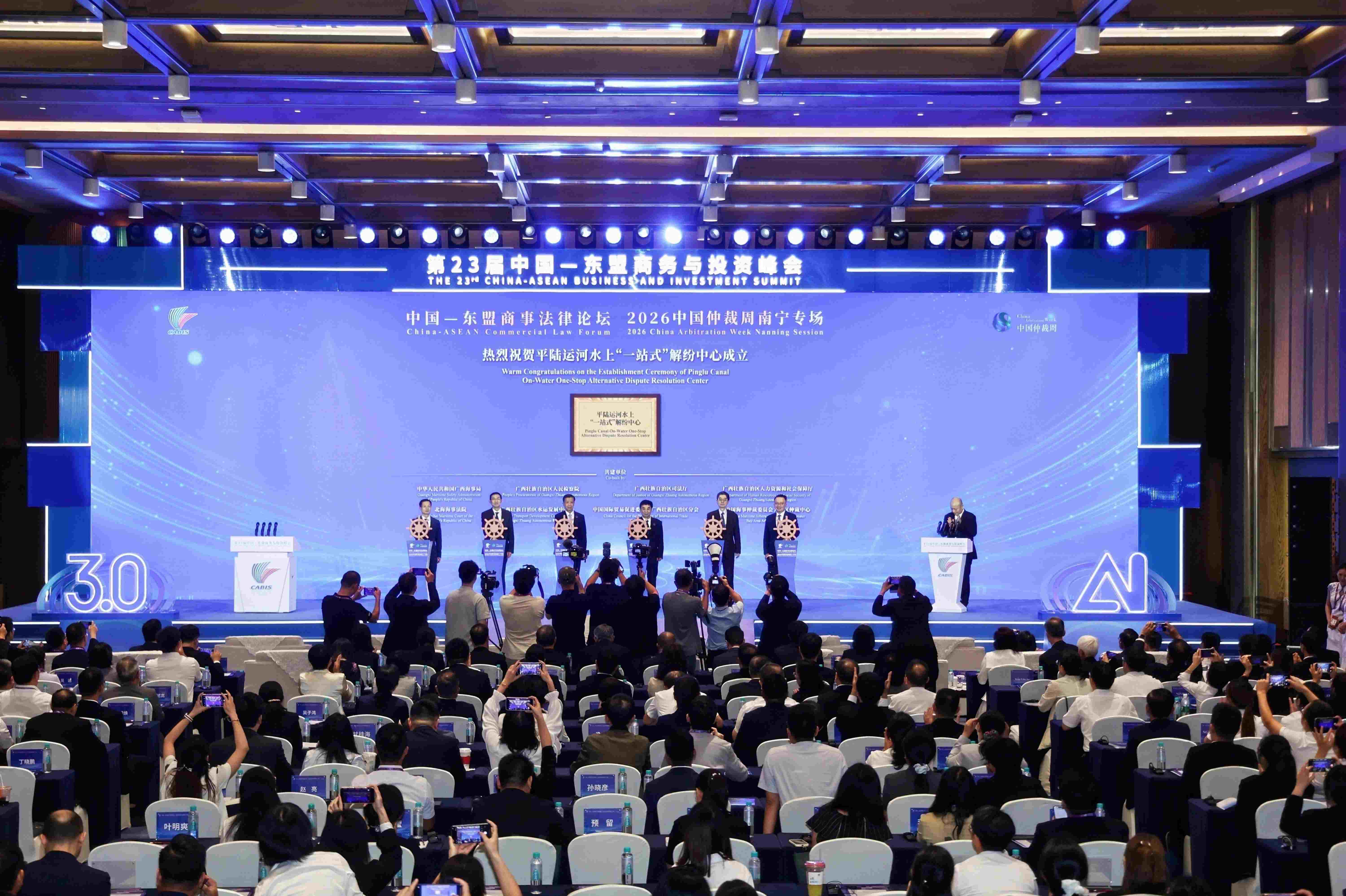
First, Pinglu Canal On-Water One-Stop Alternative Dispute Resolution Center was established. This center was established under the leadership of the Guangxi Maritime Safety Administration of People’s Republic of China, and jointly built by the People’s Procuratorate of Guangxi Zhuang Autonomous Region, the Department of Justice of Guangxi Zhuang Autonomous Region, the Human Resources and Social Security Department of Guangxi Zhuang Autonomous Region, the Beihai Maritime Court of the People’s Republic of China, the Guangxi Zhuang Autonomous Region Water Transport Development Center, the China council for the promotion of international trade Guangxi committee, and the China Maritime Arbitration Commission Greater Bay Area Arbitration Center. The Center links mediation and judicial confirmation with litigation, labor arbitration and commercial arbitration. It handles Canal-related disputes both online and offline, including waterborne traffic accidents, crew labor disputes, vessel pollution and cargo transportation, and provides coordinated resolution, confirmation of legal effect and procedural referral in a closed-loop process. This helps resolve shipping-related disputes more efficiently, reduce the time costs for enterprises in safeguarding their rights, address disputes at source, improve the law-based business environment in the shipping sector, and provide solid maritime rule-of-law support for the development of the Pinglu Canal and the New International Land-Sea Trade Corridor.
Second, Qinzhou Tribunal of Beihai Maritime Court of the People’s Republic of China was established. With the approval of the Supreme People’s Court and Office of the Commission of Public Sectors Reform of the CPC Guangxi Zhuang Autonomous Regional Committee, the Qinzhou Tribunal of Beihai Maritime Court was officially inaugurated on September 16, 2026—the same day the Pinglu Canal opens to navigation. This establishment was announced to the public at the forum. The Qinzhou Tribunal exercises jurisdiction over maritime, admiralty, maritime administrative and maritime enforcement cases arising in the areas covering Qinzhou Port, Fangcheng Port, their adjacent inland waterways and harbors, as well as sections of the Zuo River, You River and Yu River running from Songcun in Nanning via Pingtangjiangkou in Hengzhou to the Pinglu Canal in Guangxi. The establishment of the Qinzhou Tribunal helps precisely meet judicial needs for national strategies including the New International Land-Sea Trade Corridor, the Pinglu Canal initiative, building a maritime power, and opening-up toward ASEAN. It addresses shortcomings in maritime judicial services in Qinzhou, Nanning and surrounding areas, shortens the reach of judicial services, delivers higher-quality and more efficient maritime judicial safeguards for enterprises and the public within its jurisdiction, and boosts the high-quality development of Guangxi’s marine economy and opening-up at a higher level.
Third, ASEAN-Oriented Alliance for Alternative Dispute Resolution in Foreign-Related Intellectual Property Matters was established. The Alliance was initiated jointly by seven organizations—including the Guangxi Law Society Intellectual Property Law Research Association, the Guangxi Commercial Mediation Association, the Guangxi Intellectual Property Association, the China-ASEAN Law School, the Guangxi Federation of Overseas Chinese Entrepreneurs, Sunshine Intellectual Property International Co., Ltd. and the Asian Institute of Alternative Dispute Resolution (AIADR). Guided by the Guangxi Zhuang Autonomous Region Administration for Market Regulation, the Law Society of Guangxi Zhuang Autonomous Region, the High People’s Court of Guangxi Zhuang Autonomous Region and the China council for the promotion of international trade Guangxi committee, the Alliance connects with arbitration and mediation institutions of ASEAN member states. It proactively links up with the national guidance system for overseas intellectual property dispute response, and promotes regular engagement and coordination between domestic resources including administrative, judicial, arbitration and mediation bodies and dispute-resolution entities in ASEAN countries. Guided by its mission of “Protecting Innovation Jointly, Resolving Disputes Diversely, Linking with ASEAN and Empowering Development through the Rule of Law”, the Alliance focuses on key areas of intellectual property rights. It has established a full-chain service mechanism featuring “prevention at the forefront, diversified dispute resolution, cross-border coordination and commercialization of outcomes”, and strives to build the “Guangxi Channel” for the diversified resolution of foreign-related intellectual property disputes targeting ASEAN. The Alliance will deliver more professional, efficient and convenient IP protection services for enterprises engaging in China-ASEAN economic and trade cooperation.
Fourth, Guangxi Law Society Artificial Intelligence Law Society was established. To thoroughly implement China’s major strategic plans for the development of new-generation artificial intelligence, and actively integrate into the Guangxi’s innovation framework of “R&D in Beijing, Shanghai and Guangzhou, integration in Guangxi, and application in ASEAN”, Guangxi Law Society has pooled high-caliber resources from academic and practical experts on AI law within Guangxi to establish the Artificial Intelligence Law Society. Based on the unique geographical advantages of Guangxi, it focuses on the collaborative innovation of artificial intelligence law in China-ASEAN, and builds a distinctive cross-disciplinary research platform featuring “law + artificial intelligence + ASEAN”. It mainly conducts cutting-edge legal theory research, promotes practical rule innovation, and reserves comprehensive legal talents, so as to solve the legal problems in the development of artificial intelligence, and provide solid legal guarantees and intellectual support for Guangxi to build an artificial intelligence industrial highland facing ASEAN.
Fifth, the Collection of Typical Cases of the People’s Courts in Serving and Guaranteeing the Development of the New International Land-Sea Trade Corridor was released. This collection brings together two batches of representative cases released by the Supreme People’s Court over the past two years. It systematically showcases the pragmatic outcomes of people’s courts in supporting the development of the New International Land-Sea Trade Corridor across five areas: refining adjudicative rules, protecting the rights and interests of Chinese and foreign parties on an equal footing, fostering diversified dispute resolution mechanisms, advancing judicial assistance and foreign law ascertainment, and offering guidance on cross-border transport rules, so as to foster a more stable, transparent and predictable rule-of-law environment for ASEAN enterprises and investors, and promote the steady and sustainable development of regional economic and trade cooperation.
Sixth, the Collection of Typical Cases on New International Land-Sea Trade Corridor Cross-Border Intellectual Property Rights Protection was released. This collection was jointly launched by the Guangxi Zhuang Autonomous Region Administration for Market Regulation, the High People’s Court of Guangxi Zhuang Autonomous Region, the Department of Justice of Guangxi Zhuang Autonomous Region, and the China council for the promotion of international trade Guangxi committee through an open call for submissions from the public. The selected cases cover various intellectual property disputes involving trademarks, patents, copyrights, trade secrets and other categories, covering different disposal dimensions including administrative protection, judicial adjudication, arbitration and mediation, and corporate response strategies. Among them are benchmark cases where Chinese enterprises successfully safeguarded their legitimate rights by leveraging rules in Section 337 investigations, as well as practical samples of foreign-related IP disputes such as responses to malicious overseas trademark squatting, joint rights protection for cross-border e-commerce, and overseas trademark confirmation litigation. These cases not only offer risk-prevention guidance for enterprises engaging in outbound investment, but also provide practical references for relevant authorities and legal service institutions in handling similar cases. They represent a concrete achievement of Guangxi in supporting the high-quality joint development of the New International Land-Sea Trade Corridor and deepening China-ASEAN economic and trade cooperation.
Seventh, the Guangxi Foreign-Related Civil and Commercial Dispute Joint Resolution Mechanism: Collection of Typical Cases and Examples for the Third Anniversary was released. In July 2023, the Opinions on Establishing a Coordination Mechanism for Foreign-related Civil and Commercial Disputes in Guangxi were
jointly issued by the High People’s Court of Guangxi Zhuang Autonomous Region, the People’s Procuratorate of Guangxi Zhuang Autonomous Region, the Department of Justice of Guangxi Zhuang Autonomous Region and the China Council for the Promotion of International Trade Guangxi Committee. Over the past three years, all member entities have actively pooled diverse legal resources including litigation, procuratorial supervision, arbitration, mediation and foreign-related legal services, pioneered an all-round, multi-tiered linked dispute resolution system and developed a number of typical cases of exemplary value. The cases released on this Collection include those featuring representative application of law, as well as others that illustrate sound application of the coordinated dispute-resolution mechanism and diversified dispute-settlement approaches with remarkable outcomes in social governance. They systematically demonstrate the operational performance of Guangxi’s coordinated resolution mechanism for foreign-related civil and commercial disputes, and offer vivid practical experience for continuously improving the ASEAN-oriented foreign-related law-based business environment.
Eighth, the Collaborative Mechanism for Resolving Cross-Border Commercial Disputes to Support the High-quality Development of the Guangdong-Hong Kong-Macao Greater Bay Area and China-ASEAN Free Trade Area (CAFTA) has been launched. This mechanism was jointly established by the Nanning Railway Transportation Intermediate Court (the China-ASEAN Free Trade Area Nanning International Commercial Tribunal), the Intermediate People’s Court of Guangzhou City of Guangdong Province (the Guangzhou International Commercial Tribunal), CCPIT Guangxi Committee and CCPIT Guangzhou. For the first time, it created a coordinated channel for resolving commercial disputes linking the Guangdong-Hong Kong-Macao Greater Bay Area and Guangxi and extending jointly to ASEAN.The mechanism brings together the geographical advantages of the Guangdong-Hong Kong-Macao Greater Bay Area and Guangxi in engaging with ASEAN, as well as their strengths in foreign-related and Hong Kong- and Macao-related legal service resources. It has established a collaborative dispute-resolution framework featuring organic connectivity and resource sharing among mediation, arbitration and litigation, and represented an important institutional innovation in supporting the high-quality development of China-ASEAN economic and trade cooperation and high-standard opening up.
Ninth, the Association Standard—Guidelines on Trade Secret Protection for Enterprises Engaged in Generative AI Synthetic Technology was released. The standard was jointly compiled by the Guangxi Institute of Standards and Technology together with relevant institutions from China, Cambodia, Indonesia, Malaysia, Thailand and Vietnam. Against the broader backdrop of China-ASEAN cooperation on digital economy security and opening-up, it sets out the overall guidance and technical requirements for trade secret protection in the field of artificial intelligence, and provides practical guidance on preventing risks such as model theft and data leakage. The standard provides a basis for enterprises to conduct compliant operations and engage in fair competition, helps improve the law-based business environment for China-ASEAN cooperation in the digital sector, and helps build a new pattern of regional digital industry cooperation that is secure and controllable, fair and orderly, and mutually beneficial through “soft connectivity” in standards.
Tenth, a number of International Commercial Legal Agreements were signed. CCPIT Guangxi Committee signed a Memorandum of Understanding with the Vietnam International Arbitration Center (VIAC) and another MOU with the AALCO Hong Kong Regional Arbitration Centre. The China-ASEAN Commercial Arbitration Cooperation Center signed a Memorandum of Cooperation with Guangxi Minzu University. The scope of cooperation covers such areas as legal and policy information sharing, promotion of the commercial arbitration system, assistance in the enforcement of arbitral awards, and joint organization of training sessions. It will effectively integrate the resource advantages and professional capabilities of all parties, and continuously expand the commercial legal-service network, and provide strong support for enterprises in resolving disputes arising from cross-border trade.
The expert presentations were colourful and fruitful. Dr. James Ding, Law Officer (International Law), Department of Justice, Hong Kong SAR, gave an introduction to Hong Kong’s common law system under “One Country, Two Systems”, its well-established legal services and pool of legal talent, as well as its diverse dispute resolution services. He also proposed extending Hong Kong’s legal services to ASEAN through the “Nanning Channel” by means of joint training, and jointly developed platform. Prof. Zhang Ping, Director of the AI Security and Governance Center, Peking University Institute of Artificial Intelligence, centered on consensus, conflicts and institution-building in global AI ethics governance, elaborated on limited consensus, value divergences, divergent approaches and structural contradictions within current AI ethics governance, and put forward governance ideas of observing bottom lines, embracing diversity and inclusiveness, and pursuing collaborative governance. Prof. Dr. Le Hong Hanh, President of Vietnam International Arbitration Centre, against the backdrop of emerging trends in Vietnam-China economic and trade investment and the legal challenges encountered, shared Vietnam’s practical experience and institutional innovations in international commercial arbitration for resolving regional economic and trade disputes. Mr. Nick Chan, Director of AALCO Hong Kong Regional Arbitration Centre, introduced how the Centre draws on the dispute settlement system of the Asian-African Legal Consultative Organization (AALCO), leverages Hong Kong’s unique strengths to build a cross-regional platform for commercial dispute resolution. Prof. Yun Zhao, Representative of HCCH Regional Office for Asia and the Pacific, systematically reviewed the cooperation history between HCCH and ASEAN, and elaborated, from three perspectives including advancing the broad application of the convention system, boosting regional capacity-building and rule coordination, and establishing regional platforms for dialogue and experience exchange, on HCCH’s bridging role in deepening commercial legal cooperation between Hong Kong SAR and ASEAN. Mrs. Janice Choi, Standing Committee Member of the Tianjin Municipal Committee of the CPPCC, Chairperson of Legal Committee of Guangdong-HK-Macao Bay Area Entrepreneurs Alliance shared the key legal challenges faced in cross-border investment and business operations and strategies for addressing them from an entrepreneurial perspective, drawing on real-world cases of Greater Bay Area enterprises “going global”.
Since its inception in 2014, the China-ASEAN Commercial Law Forum has been held for twelve years. It has become an important platform for supporting the development of the China-ASEAN Free Trade Area and promoting regional rule alignment. Leveraging Guangxi’s unique geographical advantages in engaging with ASEAN, the Forum promoted the concentration of Hong Kong’s legal service resources in Guangxi and their further expansion into ASEAN. With Guangxi providing platforms and channels, Hong Kong contributing expertise in rules and legal services, and enterprises from China and ASEAN benefiting from more convenient and efficient legal support, the three parties give full play to their respective strengths and act in synergy to jointly deliver solid legal support for the development of the Pinglu Canal Economic Belt and the implementation of the China-ASEAN Free Trade Area 3.0 initiative. The successful convening of the Forum has not only injected new elements of Hong Kong-based rule-of-law practices into the deepening of the China-ASEAN Comprehensive Strategic Partnership, but also contributed solid strength to building an even closer China-ASEAN community with a shared future.


